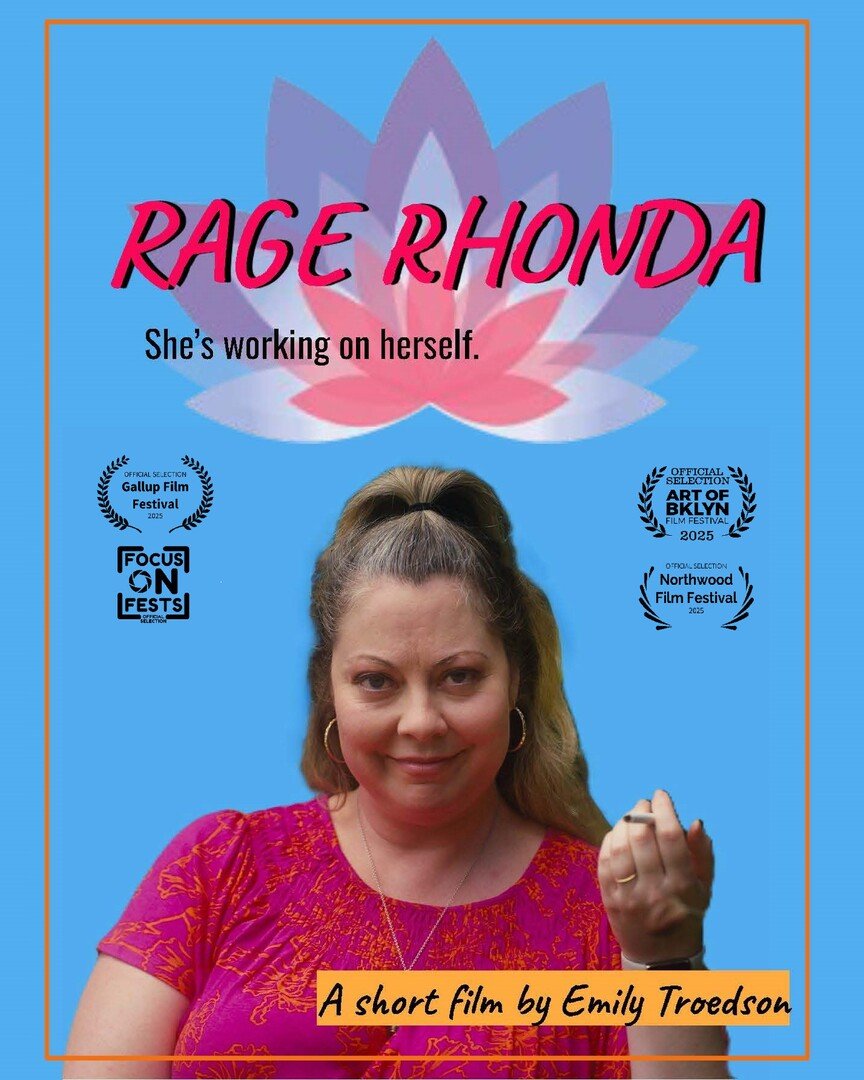
5Q's w/: Emily Troedson "Rage Rhonda" Director, Writer, Producer
QUESTION#1: What about your film excites you the most?: I love how the story makes an audience both laugh and cry a little, in a good way. Our film weaves together a lot of different themes and ideas. It’s a dark comedy crime story about loss, meditation and self-acceptance. It’s funny, it’s tender, it’s edgy and most of all, it’s hopeful.
QUESTION#2: What is it about your current movie that will influence your next film?: Loss and grief are themes I often write about in my films. In Rage Rhonda I focused on the healing and acceptance part of loss, while setting the story in a toxic work situation in order to explore how grief shows up in our work places and impacts our mental health. Rhonda discovers an eternal part of herself, which is the key to letting go of her anger. That eternal aspect of the self is definitely something that’s central to my next film, The Dark Days of Cassidy Krystian. It deals with many of the same themes, but from a much darker and mythical lens. It’s an Indigenous-driven, fantasy-action story about one woman’s difficult journey on the way to healing, moving from grief to acceptance.
QUESTION#3: When you’re shooting a film, do you think of time as something you capture or something you construct?: Capturing time, though it’s really a combination of both. Everything that happens until the second we start filming feels like constructing time. But once we start rolling, all of our preparation work has been in service to capturing that singular moment in time, especially with the performances. There’s a scene in Rage Rhonda that was scripted but had no dialogue. It was just a moment with the main character, Rhonda, played by Laura Bohlin. When we were filming that scene, she and I talked about how she should improvise the moment and just see what happens. And it was powerful. She was so present to that scene and character, and we captured gold because of it. It was better than anything we could have planned. And yet, because everyone had done good prep work toward constructing time, we were able to capture that flash of inspiration, which arose in an instant of time. That’s where the magic of filming happens.
QUESTION#4: What’s a limitation you wish you had on your next shoot that would force you into making interesting creative decisions?: Well, limitations are nothing new for most of us indie filmmakers. My first feature, for example, Blue Balloons, I made for about $10,000, plus a lot of in-kind donations from many generous people. I was able to do that because it was my first feature about a subject people deeply cared about: cancer and caregiving. But making films for no money is not a sustainable way of working, and the industry as a whole is in a flashpoint right now about the future of filmmaking. I think Sean Baker said it best when talking about indie films not just being “calling card” films on the path to something corporate. Some people may want that and that’s great if that works for them. For me, it’s about whole-heartedly embracing independent filmmaking as a deep community of creative believers who see making indie films as a way of life and solidarity. But it requires us to all do our part to build sustainable models for independent films and the talented humans who make them, both above the line and below the line. So I guess I see limitations as both a call to action to support indie film, from concept to theatrical release, as well as my own personal creative ethos that I pour into all of my films.
QUESTION#5: If a film shoot is like a living organism, which department do you think functions as its nervous system?: The writer/director in me knows that the script is the creative system from which the entire film will grow; however, having cut my teeth for over a decade producing projects, to me, it’s the Producer and the production department that really is the brain of a film shoot. Just like the nervous system absorbs and responds before being consciously aware of something, producers are the ones responding to an issue or a need long before the film shoot or “film mind” is aware. They absorb and respond to everything that happens in the creation and release of a film. No other department is responsible for that. It takes a tremendous amount of talent and skill, not to mention the high-stress toll. So I have a deep, abiding respect for the work of producers, having been there myself. Truly, no film would exist without them.
Social media tags to share with our readers: @troedem, @goatsongfilms